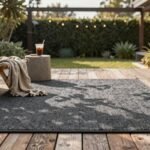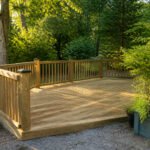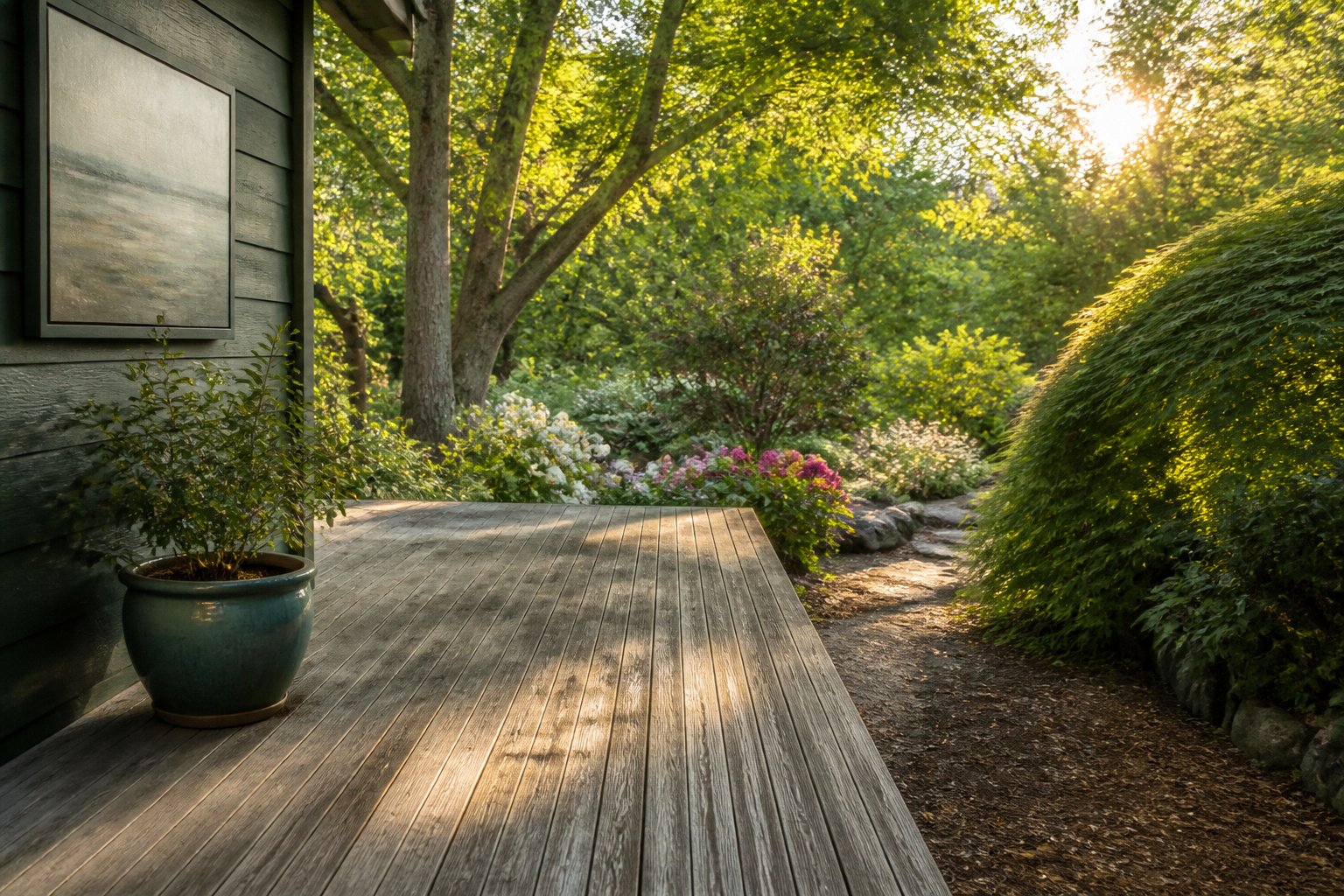
Backyard decks run from a single Saturday build on plastic piers to a multi-year savings plan for full outdoor kitchens with plumbed gas and power.
What separates them is height: keep the surface within eighteen inches of the ground and freestanding, and TuffBlock pads plus a drill will handle the foundation in an afternoon.
Cross that line for railings, stairs, or a ledger bolted to the house, and permits, frost-depth footings, and professional labor become unavoidable.
1. Modern Deck Designs

Wide, low-profile platform decks that sit close to the grass feel current because they read as an extension of the yard rather than a structure dropped on top of it.
The lines stay horizontal, the angles disappear, and the whole thing calms down visually.
I’ve noticed the railings matter almost as much as the decking itself: cable, mesh, or glass panels keep sight lines open, which makes a small footprint feel larger than it is.
Composite decking made from recycled wood fibers and plastics fits this look well. It comes in multi-tone colors now, warmer than the flat grays that dominated a few years back, and the boards won’t splinter or need annual staining.
The upfront cost runs higher than pressure-treated lumber, but the maintenance drops to almost nothing. For a modern build where you want the material to stay quiet and let the geometry speak, that tradeoff usually wins.
Built-in lighting has also shifted from afterthought to planned feature; recessed stair lights and understated rail fixtures extend usable hours without turning the deck into a runway.
The cohesion with your house matters too. One contractor in Kansas City notes that homeowners now match interior hardwood tones to exterior decking so the transition reads as a single space.
Pick boards that relate to your flooring inside, and the deck stops looking like a separate project.
Recommended Products

Easy to snap together, kids can even do it

COVERS EXPOSED EDGES: Effectively hides the exposed edges of deck tiles, giving your deck a neat and refined appearance. Designed to cap off your deck tiles, ensuring every edge is covered for a cohesive, finished look that enhances the overall aesthetic of your outdoor area.

Easy to snap together, kids can even do it
2. Traditional Deck Styles

Treated and untreated lumber still set the baseline for affordable backyard deck ideas, and the familiar look of wood grain with straightforward railings and stairs keeps the style accessible to anyone with a circular saw and a weekend.
Pressure-treated pine runs cheaper and resists rot longer, while cedar or redwood left to weather saves money upfront if you do not mind the silver-gray fade.
Either way, a deck should stay smaller than the floor area of your largest indoor room, or the structure starts to swallow the house rather than extend it.
For most layouts, that cap lands around 300 to 400 square feet, enough for a dining set and a separate seating spot without pushing past the rule.
I have drawn plenty of rectangles to that limit and found the constraint useful; it forces you to decide whether you want to eat outside or lounge outside, because doing both well takes more room than a modest yard can spare.
Recommended Products

【Application】This level drilled post serves as both a structural end and an intermediate post in leveled sections. The black cable railing post kits are designed to fit 1/8" wire rope, making them suitable for DIY stair railings, patio railings, deck railings and other outdoor and indoor railing projects. These cable railing kits feature a smooth surface, with both the posts and wire ropes in a sleek black finish, creating a modern and elegant look for your railing system.
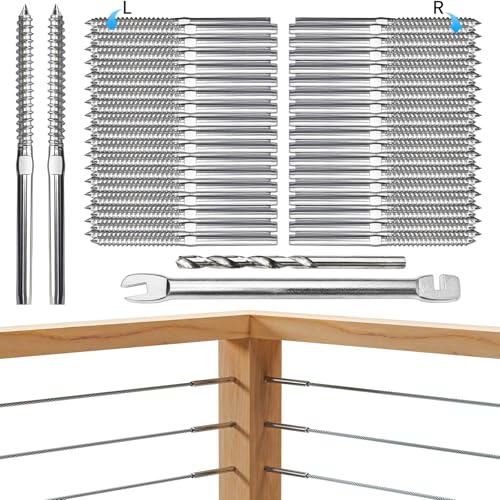
Versatile Cable Tensioning: This deck railing hardware kit is specifically designed for 1/8 inch diameter cable railing systems, these Swage Lag Screws are the ultimate solution for effortlessly adjusting cable tension. The left and right thread ensure that cables rotate in the same direction, preventing any twisting or damage, providing a smooth and secure cable railing installation.

3. Rustic Deck Concepts

Weathered cedar or redwood left to gray naturally gives a deck the worn-in look of a barn that has stood through twenty seasons.
The silvering happens faster where the sun hits hardest, so the boards age unevenly, each one telling a different story about the yard’s light.
I have learned to leave the knots and the occasional crack alone rather than replace the board; the imperfection is the point, and a two-dollar wood filler tube would undo it.
Reclaimed lumber carries this even further. Old factory beams or dismantled fence posts arrive with nail holes, saw marks, and stains that no new material can mimic.
The cost often runs lower than premium decking because you are buying what someone else considered scrap, though you will spend time pulling old fasteners and checking for rot.
I sort the pile on delivery and set aside anything too soft for foot traffic; it becomes the facing for a planter box or the back of a bench where load is lighter.
The boards that survive the test get face-screwed with dark fasteners left visible, a small honest signal that this was built by hand and not dropped in by crew.
Let the wood stay unfinished if you want the rustic effect to deepen. A single coat of penetrating oil in year one, then nothing, and the deck will look like it grew there.
Recommended Products

【30 Degree Tilt on LED Board】The 1 Inch Recessed Step Light is a clean, modern lighting solution for stair and deck lighting applications, with no unwanted glare. A 30° tilt to the internal LED board creates a natural downward beam that eliminates the need for a visor and allows for a sleek, flat design.
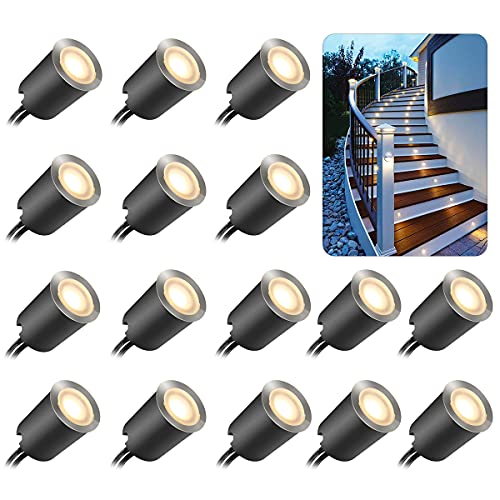
【High Bright &More Safe】Bright warm white LED deck lighting bring impressive starry effect, making you feel sweet and comfortable in your house. Add the black protecting shell for embedded installed on floor/stone stairs will be safer for led deck lights kit.

Complete Recessed Deck Lighting Kit: Includes 1 × light-sensing transformer, 16 × recessed deck lights. Each ending of wire has a male/female connector for easy installation. Simply connect the corresponding connectors between each light, then attach the first light's connector to the transformer to complete the circuit. No hard wiring is required for this kit of LED deck lights
4. Minimalist Deck Ideas

A small deck rewards the same discipline as a tidy workbench: everything earns its place or it goes. Built-in perimeter seating frees the middle for a table or open lounging, and that open middle is what reads as room.
I learned this after crowding my first narrow deck with two folding chairs and a cart that never held anything but dust; the floor disappeared.
Light colors and uncluttered surfaces stretch the space visually. A single bold feature, one pergola or one fire bowl, reads as designed rather than crowded.
Diagonal board layout does the same widening trick at no extra cost. Keep the palette restrained and the eye travels across the whole plane instead of stopping at every object.
Multi-functional furniture helps, though I would pick built-ins first. Storage built into the bench avoids the clutter that kills the effect.
Small touches of color and greenery work, but one or two beats three or four every time. A mirror hung on house siding reflects the space back on itself, an odd choice outdoors until you see it work.
Wood-look or metal-look plastic stands up to weather without the maintenance.
A minimalist deck works as a calm threshold between house and yard, not a room stuffed outside.
Recommended Products

Versatile Applications: These foundation blocks are ideal for various projects, including decks, sheds, pathways, raised walkways, and other outdoor structures. Designed for...
5. Budget-Friendly Deck Options

A ground-level deck can go from lumber pile to usable space in one or two days if the foundation is right. That speed matters when your weekend is the only window you have.
TuffBlock deck blocks handle that foundation without concrete or post-hole digging. Each block weighs a fraction of a concrete pier but carries the load through a grid of recycled plastic.
The environmental footprint is smaller, the back strain is lighter, and leveling is a matter of tapping shims rather than mixing bags.
For the surface, plastic decking skips the sealing cycle entirely. It will not rot, splinter, or feed termites.
Composite or PVC decking costs less upfront than hardwood but warms in direct sun and lacks the give of real wood underfoot.
Garapa wood splits the difference if you want natural grain without the Ipe price. It comes from the same South American docks, shares the rot and insect resistance, and runs a little less dense.
That makes it easier to cut and move on a solo build. It still needs sealing to keep the color, like any outdoor wood, but the durability is there.
Western red cedar is lighter still and soft enough to dent with a dropped tool. Mahogany costs more upfront but carries the "buy it once" reputation.
For a $500–800 annual yard budget, Garapa or treated lumber with plastic blocks keeps the project in range without cutting corners that cost double later.
Recommended Products
![CLOUDY BAY [12 Pack] 3CCT Low Voltage LED Deck Lights Outdoor,2700K/3500K/5000K Selectable,Landscape Step Stair Railing Fence Light Wired,3W,12V-24V AC/DC Deck Lighting Fixtures](https://m.media-amazon.com/images/I/41vEFsRzgTL._SL500_.jpg)
THREE COLOR TEMPERATURE IN ONE FIXTURE: Cloudy Bay designed the step light with 2700K/3500K/5000K selectable LED to give off the right amount of light in the dark.

【More Comfortable Performance】: GKOLED low voltage LED deck lights have no visible screws, blending perfectly into your outdoor landscape. The full cutoff design and frosted lens can eliminate glare. These outdoor lights are ideal for deck, outdoor stairs, backyard fence, patio etc.

【Fit both Deck Posts & Steps】The compact size and cutoff design make this light an ideal choice for illuminating deck posts and stair risers.
6. Multi-Level Decks

A multi-level deck breaks the space into connected platforms at different heights, which is the best answer for a sloped yard and lets you separate zones without building walls.
Put dining up near the kitchen door and drop down a few steps to a lounge area; the change in height makes even a medium deck feel custom and designed.
The elevation shift does the zoning work that furniture alone struggles with.
On a single plane, a dining table and a pair of Adirondack chairs fight for identity; add three steps down, and the lower level reads as a destination rather than leftover space.
I have watched neighbors try to solve this with planters or screens, but the eye still reads one flat box. The step creates the boundary.
For a household working a small yard on roughly $500–800 a year, the cost jumps with each level because footings, framing, and railings multiply.
Build a multilevel deck only if your yard already slopes; the extra space and budget it demands rarely pay off on flat ground.
On flat ground, the same zone separation can be achieved for less by changing the deck surface material between areas, or by running boards in different directions.
Save the second level for where the yard drops away and the alternative is a retaining wall you did not want to pay for either.
Recommended Products

Made from high-quality plastic material, these spacer rings securely hold the deck boards in place, preventing movement and warping over time.

Easy to snap together, kids can even do it

Fasten on the edge of the deck board to provide a clean, professional, deck top
7. Outdoor Kitchens

An outdoor kitchen on a deck starts with the question of what you actually cook outside. Grills, smokers, refrigerators, ice makers, and storage can all be built into kitchen components made from aluminum, composite, or stone.
The material choice matters less than the utility run underneath. You will need a licensed plumber and electrician for gas, water, and power lines, and in most jurisdictions that work requires permits and inspection.
Skipping this to save money means ripping out finished surfaces later when something fails inspection or worse, fails in a rainstorm.
Weatherproofing is where I have seen the most expensive mistakes. Outdoor-rated appliances cost more upfront because their seals, electronics, and finishes are built to handle temperature swings and direct rain.
A standard indoor refrigerator installed under a counter overhang will rust out and void its warranty. The same goes for cheap grill carts that look built-in but leave the frame exposed.
Composite and stone housings hold up, but only if the joints are flashed and the base drains. Water pooling in a cabinet corner rots the substructure before the facing shows damage.
For a $500–800 annual yard budget, a full outdoor kitchen is probably a multi-year project. Start with a quality grill on a stone or composite base you can expand later.
Run the utilities rough-in while you are building or resurfacing the deck; adding them after is destructive and costly.
Recommended Products

30° Angled-Hole Cable Railing Post: This 36" post is pre-drilled with 10 pairs of 30° angled holes, spaced 3.31 in apart. Designed for stair protection on 25°-35° inclines to help protect you and your family. Note: This upgraded version has adjusted hole quantity and spacing vs. the previous version—please verify hole positions and count when repurchasing or matching parts. Steel cable not included

Horizontal-Hole Cable Railing Post: This 36" post is pre-drilled with 10 pairs of horizontal holes, spaced 3.31 in apart. Designed for level surfaces/deck railing protection to help protect you and your family. Note: This upgraded version has adjusted hole quantity and spacing vs. the previous version—please verify hole positions and count when repurchasing or matching parts. Steel cable not included

【Application】Black stair cable railing kits fit for 1/8'' stainless steel cable. This black adjustable angle cable railing kit has 180° angle freedom adjustable base, can be used at angle stair railing or horizontal cable guardrail. Black cable railing hardware is suitable for outdoor or indoor.
8. Decks With Pergolas or Awnings

A pergola turns an open deck into something that feels like a room without walls. The vertical posts mark where one space ends and another begins, and the overhead slats filter sunlight into stripes rather than flooding the whole area.
That partial shade is what extends usable hours: direct sun at noon becomes dappled light you can sit in, and the structure still breathes enough to let evening air move through.
You can buy one ready-made or build from lumber, and the canopy options matter more than the frame. A fixed slat roof gives steady, predictable shade.
A retractable fabric cover, like the metallic grey canopy Trex offers, lets you pull back coverage when you want morning light or slide it closed when afternoon heat hits.
Awnings work on the same principle if you want something attached to the house wall rather than freestanding.
For small yards, a pergola does double duty as a privacy screen. Train a climbing vine up the posts, hang a curtain panel on one side, or leave it open and let the vertical lines alone suggest a boundary.
The structure reads as architecture, not furniture, so it anchors the space even when the furniture changes.
Recommended Products

【High Bright &More Safe】Bright warm white LED deck lighting brings an impressive starry effect, making you feel sweet and comfortable in your house. Adding the black protective shell for embedded installation on the floor/stone stairs will make the LED deck lights kit safer.

【High Bright &More Safe】Bright warm white LED deck lighting bring impressive starry effect, making you feel sweet and comfortable in your house. Add the black protecting shell for embedded installed on floor/stone stairs will be safer for led deck lights kit.

【Light Dimension】: Light Size: Φ35mm (1.38inch) x H25mm(0.98inch). Mount Hole Size: Φ24mm. Distance Between Light to Light: 3.28ft. Providing comfortable 3500K warm white light illumination, the low voltage deck lights is a great product to illuminate your home and garden and can easily beautify your living environment.
9. Cozy Outdoor Living Spaces

An outdoor rug is the cheapest way to make a deck feel like an actual room rather than a platform attached to your house.
I picked one up for under forty dollars last season, laid it under a pair of deck chairs, and the space stopped looking like leftover construction and started looking like somewhere you’d sit on purpose.
Multi-level decks especially benefit from this trick: a rug on each level defines the zones without building walls.
Furniture does the real work of making a deck lived-in. A sofa or daybed turns the space into an extension of your home, not an afterthought.
I built mine from plans I found online; the materials ran about half what store-bought would have cost, and the thing still looks solid two years later.
For smaller corners, a single Adirondack chair with a side table and a stack of pillows creates a reading nook that pulls you outside.
Lighting matters more than most people think. Recessed lights set into stairs or posts keep the deck usable after dark and feel high-end without the high-end price.
String lights overhead, a few textiles layered in, and suddenly you’re staying out past sunset because the space asks you to, not because you forgot to go in.
10. Fire Pits and Swings

A fire pit turns a deck from a platform into a destination, but the wrong placement turns it into a hazard.
Portable units work best on smaller decks where you need flexibility; built-ins make sense only when the square footage justifies a permanent focal point.
Gas gives instant flame, wood-burning gives the campfire feel, and tabletop bowls split the difference for tight spaces.
Keep any fire feature at least three feet from railings, walls, and overhangs, and never set one directly on a wood surface without a heat shield or non-combustible base.
Swings carry a different risk. A porch swing looks innocent until you realize the dynamic load of two adults dropping into it can exceed four hundred pounds.
Most deck joists are not sized for that kind of point load. Before hanging anything, check that your framing can handle it, or add a header to spread the weight across two or more joists.
For renters or anyone unsure of the structure, a freestanding A-frame swing keeps the physics off the deck entirely.
Recommended Products
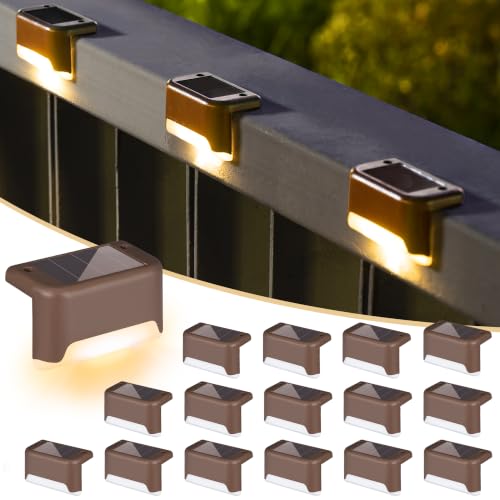
【Warm Light without Dazzling】This deck light features a 𝐁𝐫𝐨𝐰𝐧 𝐬𝐡𝐞𝐥𝐥 and warm white LED, decorate and illuminate your fence, deck, stairs, patio, balcony, yard, or garden. It ensures safer nighttime navigation for the whole family when going downstairs

1 - 18 Watt Bulb (Included)

【WARM LED LIGHT】Warm white deck light, just the right amount of warm glow which is safer for the whole family to go downstairs at night
What I Spend and Where I Skimp

A pressure-treated platform deck with string lights is the only full build that lands inside a single-season budget. Most worthwhile deck work means saving across two or three seasons to gather enough.
- Reuse what you already have. Keeping the joists and framing from an old deck, then swapping in new surface boards or modular ipe tiles, skips demolition and new framing entirely. That single choice drops the cost more than any other.
- Put your money into the frame, not the shape. A clean rectangle with solid framing looks better than a fancy footprint built cheap.
- Buy lumber during hardware store sales and sign up for email alerts to catch them. The savings are real but unpredictable, so plan the project around the sale, not the other way around.
- Handle your own sanding, sealing, and surface prep. Labor you trade for weekend hours is labor you do not pay for.
- Skip the picture-frame border, built-in seating, pergola, and lighting package until you have moved into the mid-range budget tier. On $500–800 a year, those are three-season savings goals at minimum.
Zoning a Small Deck

A 150-square-foot deck forces you to decide what matters most, because fitting everything at once is a losing fight.
I learned this the hard way after squeezing a four-top dining set and a full loveseat onto my old platform; the chairs could barely pull out, and the loveseat became a coat rack.
Built-in perimeter seating along one or two edges changes the math entirely. It keeps the center open for a table or for nothing at all, and the bench itself can lift up to store cushions or potting soil underneath.
The real flexibility comes from pieces that earn their keep twice. A narrow console table against the railing works as a buffet during dinner, then slides aside to become a potting station once the meal ends.
Garden stools stack when you need floor space and unstack to become side tables or extra perches. One designer I read suggested thinking in outdoor rooms rather than settling for a featureless platform, and that reframing stuck with me.
"People want the space to be their own. They’re thinking in terms of outdoor rooms."
For a reader with maybe twelve feet of railing, that means picking one bold vertical element, not three.
A single tall planter or a slim privacy screen draws the eye up and makes the deck feel larger; a pergola plus a fire bowl plus hanging baskets reads as clutter.
Lay the boards on a diagonal if you are replacing the surface, but do not rebuild just for that trick. The diagonal costs nothing extra in labor and stretches the space visually without stealing a single inch.
What I Check Each Spring

- A garden hose and a basic deck cleaner from the hardware store handle the whole job for me. I spray the deck down, wait about ten minutes, then scrub. No power washer. The fibers in softwood decking fray under that pressure, and I’ve seen the fuzzy gray patches that result.
- Loose nails show up fast once you start looking. I walk the boards slowly, heel first, feeling for give. A nail that has backed out half an inch catches a toe before it catches an eye. I tap them flush or swap them for deck screws that actually grip.
- Rot hides at the ledger board, the stair stringers, anywhere water sits. I probe suspect spots with a screwdriver. Soft wood that accepts the tip means a plank needs replacing, not refinishing. Catching it now means replacing one board. Missing it means joist work later, and that is where a $500 annual budget dies.
- Leaves and sticks get swept off weekly. Pooled water gets removed the same day. The ten minutes of hauling a hose and scanning fasteners each spring has, so far, kept every repair inside the cost of a takeout dinner.
Plants That Climb and Trail

A blank wall on a small deck is floor space you do not have to sacrifice.
Last spring I watched a neighbor realize she had hung her pots from the railing with wire that was already rusting into the powder coat. The marks were permanent by June.
Deck rail hangers that clamp or hook without drilling save the finish and move when you do.
For the wall itself, a simple trellis or copper obelisk gives a vine something to climb without asking for soil in the ground you may not own.
Container-friendly choices like morning glory or sweet pea fill out fast in a pot deep enough to hold moisture through August heat.
A hanging garden overhead works the same trick: the eye travels up, the deck feels larger, and your square footage stays open for the one chair you actually sit in.
When I Hire and When I Don’t

A ground-level deck sitting on TuffBlock pads is the line I draw for my own tools and Saturdays.
No concrete, no digging, no permit visit to the township; the blocks go down in an afternoon and the frame locks together over them. That scope is real for a beginner with a drill and a level.
The other side of that line starts the moment you want elevation: railings, stairs, anything attached to the house. Those builds need footings below the frost line and a permit in almost every jurisdiction I have checked.
The cost difference is not just materials; it is the crew that can pour and wait for cure time, and the inspector who signs off before you bolt the ledger.
How to tell which side your idea falls on? Measure the finished height against your threshold.
Under about eighteen inches and freestanding, TuffBlock and a weekend are honest options.
Above that, or bearing on the house, you are buying professional labor or you are asking for a sagging frame and a red tag from the code office.
I have priced both paths, and the split is clean: pads for the flat yard and the low platform, footings and a contractor for everything else.
Frequently Asked Questions
What is the most popular deck design?
A single-level platform or raised deck in low-maintenance composite is the most common. It fits the widest range of homes and budgets, and multi-level designs are the fast-growing favorite for sloped yards.
What is a good size for a deck?
Keep the deck smaller than the floor area of your largest indoor room, or it starts to swallow the house. For most layouts, that cap lands around 300 to 400 square feet, enough for a dining set and a separate seating spot.
What are some affordable decking materials?
Treated and untreated wood, composite decking, and plastic are all budget-friendly options. Pressure-treated pine runs cheapest, while composite skips the sealing cycle and plastic decking avoids rot and insect damage entirely.
Can I build a deck myself to save money?
Yes, a ground-level deck on TuffBlock pads is honest weekend work with a drill and level. Skip the DIY path once you want elevation, railings, stairs, or anything attached to the house; those need footings, permits, and professional labor.
How can I maintain my deck on a budget?
Spray the deck with a garden hose and basic cleaner, wait ten minutes, then scrub by hand. Skip the power washer; it frays softwood fibers.
Walk the boards heel-first to feel for loose fasteners, probe suspect spots with a screwdriver, and sweep off leaves weekly so water never pools.
What is the average cost of a 20×20 deck?
Most worthwhile deck work means saving across two or three seasons on a $500–800 annual yard budget, with a pressure-treated platform deck being the only full build that lands inside a single season.
What is the average cost of a backyard deck?
A pressure-treated platform deck with string lights is the only full build that fits a single-season budget of $500–800.
Most projects require saving across two or three seasons, and mid-range features like built-in seating, pergolas, or lighting packages need at least three seasons of savings.
What are the latest garden decking trends?
Modern builds favor low-profile platforms that read as yard extensions, with cable, mesh, or glass railings that keep sight lines open.
Composite decking has shifted to warmer multi-tone colors, and homeowners now match interior hardwood tones to exterior decking so the transition reads as a single space.