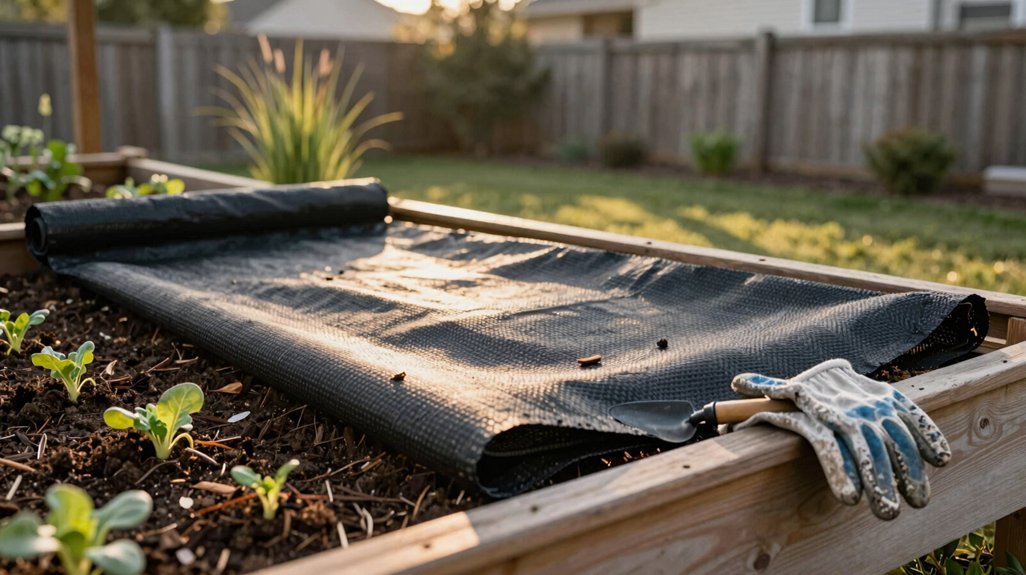
Landscape fabrics work by blocking sunlight from reaching weed seeds while letting water and nutrients pass through tiny pores. I judge quality by weight (3+ ounces per square yard means durability), weave tightness, and UV stabilization that prevents breakdown in sunlight.
These seven picks suit homeowners with medium to large beds who don’t mind occasional staple replacement. Cheaper options degrade faster under heavy mulch.
My favorite? The Pterying 6.5x300ft delivers serious coverage per dollar, but you’ll want to see why width matters more than you think.
LAVEVE 4FT x 100FT Heavy Duty Weed Barrier Fabric
The LAVEVE 4FT x 100FT Heavy Duty Weed Barrier Fabric works through a woven polypropylene mesh, a plastic fabric with cross-woven threads that block weeds while letting water and air seep through to your soil. The cross-weave structure breathes. It resists UV damage. Soil stays healthy beneath it.
I measure value by coverage and durability. You get two 4x50FT rolls totaling 100 square feet of professional-grade material. The 3.2oz weight handles foot traffic and light construction loads. Green guide lines simplify alignment. Household scissors cut it clean.
This suits gardeners wanting straightforward installation without specialized tools. The caveat: you’ll need U-pegs separately. Heavy clay soils may need supplementary drainage planning.
My favorite feature is the permeability balance. Water penetrates. Weeds don’t. For vegetable plots, flower beds, and gravel paths, this delivers exactly what I expect from barrier fabric. No surprises. Solid performance.
Best For: Gardeners and landscapers seeking an easy-to-install, durable weed barrier for vegetable plots, flower beds, gravel paths, and light construction projects who prioritize permeability and straightforward maintenance without specialized tools.
Pros:
- Cross-weave polypropylene construction blocks weeds while allowing water and air penetration to maintain soil health
- Clear green guide lines and scissor-cuttable material enable simple, tool-free installation
- 3.2oz heavy-duty weight resists UV damage and handles foot traffic plus light loads
Cons:
- U-shaped securing pegs required for installation are not included and must be purchased separately
- Heavy clay soils may require additional drainage planning beyond the fabric’s standard permeability
- Two-roll packaging (4x50FT rather than single 4x100FT roll) may complicate large continuous coverage projects
Pterying 6.5x300ft Weed Barrier Landscape Fabric Heavy Duty, 3oz
What makes a weed barrier truly heavy-duty? Tensile strength separates professional-grade products from disposable alternatives. The Pterying 6.5x300ft Weed Barrier delivers 146 pounds of resistance per 5-centimeter strip, with full-width capacity reaching 600 pounds. This woven polypropylene, 3 ounces per square yard, withstands gravel loads without tearing.
I evaluate landscape fabric on three criteria: mechanical durability, permeability balance, and installation efficiency. This product blocks sunlight to prevent weed germination while maintaining water and air penetration—critical for root oxygenation. The green alignment stripes enable straight placement; standard scissors handle cutting, though taping cut edges prevents fraying.
This suits large-scale projects: 1,950 square feet covers substantial beds, driveways, or erosion zones. My caveat: the 3-ounce weight demands secure anchoring in wind-prone areas.
I recommend this for landscapers needing commercial coverage without premium pricing. The size-to-strength ratio makes it my favorite value option for 2026.
Best For: Landscapers and homeowners tackling large-scale outdoor projects who need commercial-grade tensile strength and coverage area without premium pricing.
Pros:
- Exceptional tensile strength (146 lbs per 5cm strip, 600 lbs full-width) withstands heavy gravel loads without tearing
- Maintains optimal permeability balance—blocks weeds while allowing water penetration and air circulation for healthy root oxygenation
- Large 1,950 sq ft coverage with green alignment stripes enables efficient, straight installation on substantial projects
Cons:
- 3-ounce weight requires secure anchoring in wind-prone conditions to prevent displacement
- Cut edges fray without additional taping, adding minor labor to installation
- Woven polypropylene construction may degrade faster than non-woven alternatives in high-UV environments over extended periods
FEED GARDEN 4FT x 100FT Landscape Fabric Weed Barrier (2 Pack)
Who needs reliable ground coverage without constant maintenance? I found my answer in FEED GARDEN’s 4FT x 100FT Landscape Fabric Weed Barrier.
This heavy-duty woven polypropylene (a tough plastic fabric) delivers serious tensile strength for long-term durability. The kit includes 30 U-shaped stakes for secure fastening and clear green guide lines for precise plant alignment. I appreciate that it cuts easily to any shape.
Water and air permeate freely through this breathable barrier, protecting soil health beneath gardens, lawns, vegetable plots, flower beds, even driveways and construction sites. Two 4FT x 50FT packs fold neatly for transport.
My favorite feature? The efficient after-sales support. FEED GARDEN stands behind this product completely. Contact them directly if issues arise. They’ll resolve problems fast.
One caveat: folded packaging creates creases requiring flattening before installation.
I recommend this for small-to-medium projects demanding practical weed suppression.
Best For: Gardeners with small-to-medium outdoor projects seeking practical, low-maintenance weed suppression across gardens, lawns, vegetable plots, and driveways.
Pros:
- Heavy-duty woven polypropylene construction delivers strong tensile strength for long-term durability and reliable ground coverage
- Highly breathable and permeable design allows water and air to pass through freely, protecting soil health beneath the barrier
- Includes 30 U-shaped stakes and clear green guide lines for secure installation and precise plant alignment, plus easily cuts to any custom size or shape
Cons:
- Folded packaging creates creases that require flattening before installation, adding preparation time
- Two 4FT x 50FT packs rather than single continuous roll may create seams in larger installations
- Moderate coverage capacity may prove insufficient for expansive landscaping projects
Sunocity 4ft x 300ft Black Weed Barrier Fabric
Why choose Sunocity’s 4ft x 300ft barrier? I appreciate its woven polypropylene construction, a plastic fabric interlaced for strength. This 3.5 oz material resists UV damage. It breathes. Water and air pass through, so soil stays moist without drowning roots.
I measure value by coverage per dollar. Three hundred feet handles large projects. I cut sections with scissors. No special tools required.
The package includes ninety staples. I drive these into edges to prevent shifting.
This barrier suits gardeners needing extensive ground coverage. I caution: folded packaging sometimes confuses buyers about actual width. Verify dimensions before planting season.
I recommend this for mulch beds and gravel paths. My favorite feature is the cross-weave durability. It simply lasts.
Best For: Gardeners and landscapers needing extensive ground coverage for mulch beds, gravel paths, or large-scale weed control projects who prioritize durability and ease of installation.
Pros:
- Woven polypropylene construction with UV-resistant cross-weave provides long-lasting durability
- Permeable design allows air and water penetration while maintaining soil moisture
- Generous 300-foot length with included 90 staples offers excellent coverage value and easy installation
Cons:
- Folded packaging can create confusion about actual product width
- Requires careful verification of dimensions before use
- 4-foot width may necessitate multiple seams for very wide coverage areas
GDNaid Heavy Duty Weed Barrier Landscape Fabric (4ftx100ft)
This heavy-duty barrier suits gardeners who demand professional-grade weed suppression across large areas. I find the GDNaid 4ftx100ft model delivers exactly that.
The 3.2oz polypropylene construction stops weeds cold while letting water and nutrients pass through to your soil. This mechanism keeps plants healthy without constant maintenance. It’s tear-resistant and handles heavy foot traffic, even vehicles.
My favorite feature: you can cut it to any shape. Lay it over soil, add mulch on top, and you’re done. It works in gardens, driveways, and agricultural settings.
Best For: Serious gardeners and landscapers who prioritize professional-grade durability and long-term weed suppression across large areas.
Pros:
- 3.2oz tear-resistant polypropylene construction withstands heavy foot and vehicle traffic for multi-season durability
- Permeable design blocks weeds while allowing water and nutrients to reach soil, reducing maintenance needs
- Easily cut to any shape or size for flexible installation in gardens, driveways, and agricultural settings
Cons:
- Requires mulch or covering for finished appearance, adding to overall project expense
- 4ft width may require multiple seams for very large coverage areas
Pattiumo Weed Barrier Landscape Fabric 3x300FT Heavy Duty
Pattiumo builds this fabric for property owners tackling large-scale projects. The 3.2-ounce professional-grade polypropylene (a tough plastic weave) blocks light completely. Weeds die. Water flows through. That’s the mechanism.
Purchase criteria center on coverage and durability. You get 900 square feet in one roll. The green alignment lines speed installation. You cut holes for plants.
The dual-layer, needle-punched construction (compressed fibers for strength) handles vehicles and heavy foot traffic without tearing.
This matches farmers, commercial landscapers, and homeowners with driveways or gravel paths. One caveat: the roll is massive. You need space to unroll it. Folding creates weak points.
My favorite feature is the soil stabilization. It prevents landslides during heavy rain. The fabric conserves moisture underneath. Your plants thrive. Weeds don’t.
I recommend this for projects exceeding 500 square feet. Smaller jobs waste material. Install it once. It lasts years.
Best For: Property owners tackling large-scale landscaping, agricultural, or ground stabilization projects exceeding 500 square feet, including farmers, commercial landscapers, and homeowners with driveways or gravel paths who need durable, professional-grade weed control without hiring expensive professionals.
Pros:
- Heavy-duty 3.2 oz dual-layer polypropylene construction withstands vehicles, heavy foot traffic, and harsh elements without tearing
- Permeable design allows water, air, and nutrients through while blocking light completely to suppress weeds and conserve soil moisture
- Green alignment lines and roll format enable efficient installation with easy cutting for plant placement
Cons:
- Massive 3×300-foot roll requires substantial space to unroll and cannot be folded without creating weak points
- Impractical for small projects under 500 square feet where material would be wasted
- Storage and handling challenges due to size and weight of the unrolled fabric
Land Guard 4ft x 300ft Weed Barrier Fabric
The Land Guard 4ft x 300ft Weed Barrier Fabric delivers professional-grade weed suppression through a simple mechanism: dense woven polypropylene blocks sunlight from reaching buried weed seeds while remaining fully permeable to water and air.
I evaluate landscape fabrics by breathability and installation efficiency. This model excels. Its high permeability prevents water pooling, protecting soil moisture and root health.
The green stripes simplify planting alignment. I find this remarkably practical.
This suits gardeners managing medium-scale projects—retaining walls, french drains, erosion control—who need reliable underlayment without chemical herbicides. The 300-foot length covers substantial ground.
One caveat: the 4-foot width demands more seams on wide beds. Plan accordingly.
My favorite feature is the durability-to-weight ratio. It improves productivity. I recommend this for committed gardeners prioritizing environmental control over maximum heavy-duty thickness.
Best For: Gardeners managing medium-scale landscaping projects like retaining walls, french drains, and erosion control who prioritize environmental weed control without chemical herbicides.
Pros:
- High permeability allows water and air through while blocking sunlight to prevent weed germination
- Green stripes simplify planting alignment and trimming during installation
- Excellent durability-to-weight ratio improves productivity for committed gardeners
Cons:
- 4-foot width requires more seams on wide beds, demanding additional planning
- Not maximum heavy-duty thickness for those needing extreme durability
- Woven polypropylene may be less suitable for gardeners needing maximum puncture resistance
Factors to Consider When Choosing Landscape Fabrics
I evaluate landscape fabrics through five mechanical properties that determine longevity and performance in your garden. Material weight and thickness (measured in ounces per square yard) block aggressive weeds, while permeability and drainage prevent root rot by letting water pass through: my favorite combination is heavy weight with high flow rates.
UV resistance rating (the hours of sun exposure before degradation) and tensile strength durability (resistance to tearing during installation) matter enormously if you’re covering rocky soil, though I’ll warn you that installation ease features like pre-marked lines justify a 15-20% price premium only when you’re working alone.
Choose thicker woven polypropylene for permanent beds; it’s the only material I’ve seen survive five seasons without replacement.
Recommended Products
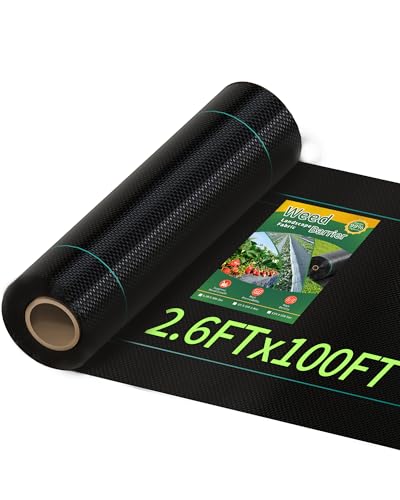
Weed Control: Woven polypropylene physically blocks sunlight to prevent weed seed germination, keeps flower beds, vegetable gardens, and landscaping weed-free without chemical herbicides.

Heavy-Duty Woven Ground Cover: Woven polypropylene fabric helps block weed growth while allowing air, water, and nutrients to move through, supporting long-term soil and plant health

Heavy-Duty Woven Ground Cover: Woven polypropylene fabric helps block weed growth while allowing air, water, and nutrients to move through, supporting long-term soil and plant health
Material Weight and Thickness
How do you know which landscape fabric won’t tear apart the moment you walk on it? I check the material weight, measured in ounces per square yard. This number tells you density and durability.
Heavier fabrics, my favorite starts around 3.2 ounces, deliver superior tear resistance and longer service life under harsh sun. They withstand gravel, mulch, and decorative stone without puncturing. The mechanism is simple: more material equals more strength.
For purchase criteria, I prioritize 3.0–3.5 ounce weights for heavy foot traffic or vehicle use. Lighter options fray badly at cut edges and demand extra edging or tape. That’s wasted time.
Match heavy weight to high-stress installations. One caveat: thickness influences water and air movement, which affects soil moisture and weed suppression. Choose wisely.
Permeability and Drainage
Why does water pool on some fabrics while others drain perfectly? The answer lies in permeability, which measures how easily water and air pass through material. Low-permeability fabrics suffocate soil. Water stagnates. Roots rot.
I always check permeability ratings before buying. Breathable fabrics let rainfall and irrigation reach soil while cutting evaporation losses. This matters. Higher permeability prevents oxygen deficiency in root zones by maintaining airflow. Your plants breathe easier.
Permeable fabrics work beautifully under mulch, gravel, or pavers. They enable drainage and stop erosion. My favorite balance: enough pore size for water and air without inviting weed germination. That’s the sweet spot.
Choose fabrics rated for your specific drainage needs. Heavy clay demands higher permeability than sandy soils. Test samples with water before full installation.
UV Resistance Rating
What happens when sunlight beats down on exposed fabric for months? It degrades, unless the material contains UV stabilizers, chemical additives that block sun damage. Manufacturers achieve this protection through stabilized polypropylene, a plastic polymer that resists photodegradation, the breakdown caused by light exposure.
Higher UV ratings guarantee longer lifespans. I always verify the claimed duration, three years, five years, twenty years, against my project timeline. Thicker, denser weaves resist breakdown better; the tight structure blocks penetrating rays.
My favorite approach: match the rating to your climate intensity. Desert sun demands maximum protection. One caveat, UV resistance alone won’t prevent tearing from rocks or roots.
Choose fabrics showing minimal color fading and zero brittleness after testing. This structural integrity preserves permeability, ensuring water flows through season after season.
Tensile Strength Durability
Durability isn’t negotiable when I’m kneeling on fabric that’ll bear stone, soil, and boots. Tensile strength, how much pulling force a fabric withstands before tearing, determines whether my investment survives one season or ten.
I check ratings per 5-centimeter strip. Heavy-duty fabrics hit 100–150+ pounds; higher full-width ratings handle vehicles or dense gravel.
Woven polypropylene with dense cross-weaving delivers my favorite combination of strength and tear resistance. Non-woven options simply can’t compete under load.
I match strength to my project. Pathways demand robust ratings; decorative beds tolerate less.
Here’s my caveat: excessive density blocks water and air. I verify permeability specs alongside tensile claims. A fabric that suffocates roots defeats its purpose entirely.
For rugged applications, I prioritize 150-pound ratings minimum.
Installation Ease Features
Installation speed separates weekend projects from weekend nightmares. I look for green alignment stripes, simple guide lines that keep rows straight and properly spaced. You cut these fabrics with household scissors or a craft knife, no special tools needed.
The permeable, breathable construction lets water and air reach soil underneath, preventing moisture buildup that weakens roots. I secure edges with U-shaped garden stakes or staples; this prevents shifting through freeze-thaw cycles.
My favorite feature: extended lengths, 4 feet wide by 100–300 feet long, because fewer joins mean faster work and fewer failure points. Choose this if you value efficiency. Avoid short rolls unless your space is tiny. I recommend pre-measuring your area, then buying one continuous roll. This saves time. This prevents headaches.
Coverage Area Needs
Once you’ve got your fabric laid out, you need enough of it. I measure my coverage area in square feet, then convert to linear units (length of fabric needed) based on roll width. Most rolls come 4 feet or 6.5 feet wide. I align my cuts with these widths to minimize joints where weeds sneak through.
I always add 5–10% extra for overlap, miscuts, and waste. Longer rolls, 100 feet, 300 feet, mean fewer seams and faster work. I factor in edges, paths, and plant beds so nothing stays bare.
My favorite approach: buy one continuous roll when possible. It costs more upfront but saves hours of seaming. Measure twice, order once.
Intended Application Type
Where exactly do you plan to use your fabric? I match my fabric to the job. For garden beds, I choose 4 ft widths; for paths, I prefer 6.5 ft. Heavy traffic demands 3.0 oz weights, dense weaves resist tearing under vehicles.
I check perforation (tiny holes) for water and air flow; roots suffocate without permeability. Soil stabilization needs differ from simple weed suppression, I verify compatibility with my surface, whether soil, gravel, or mulch. Green guide lines are my favorite feature; they enable straight cuts and neat edges. Lengths of 100–300 ft prevent wasteful seams.
Your application dictates every specification. Choose wrong, and you’ll replace it. Choose right, and it lasts years.