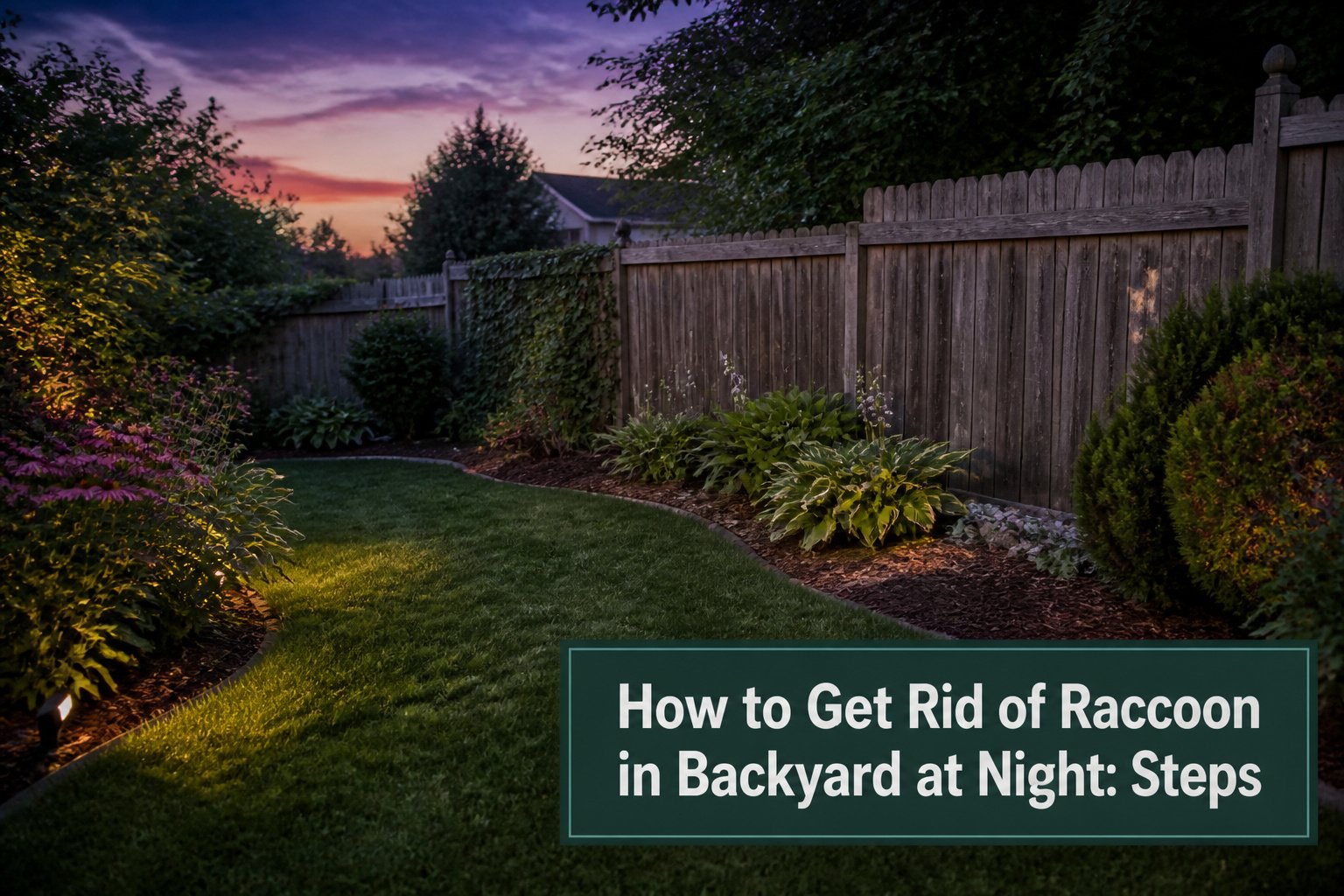
Getting rid of raccoons in your backyard at night takes about an hour of setup and roughly thirty to fifty dollars in materials, but the step most people skip is sealing gaps smaller than four inches.
Raccoons squeeze through openings no wider than a deck of cards, and until you close those, no deterrent keeps them out for long.
1. Identify Signs of Raccoon Presence

Raccoon tracks look like tiny human handprints, five splayed fingers pressing into soft soil or mud. I check garden beds and lawn edges after rain, where the ground holds impressions best.
The droppings give them away too: blunt-ended, segmented, about three-quarters of an inch across and two to three inches long, often packed with seeds, berry skins, or telltale garbage remnants from last night’s raid.
They can squeeze through a gap as small as four inches, so an opening I might dismiss as too tight for anything larger than a mouse could be their highway.
Digging damage spreads wider than what skunks or squirrels leave behind. Raccoons tear sod in ragged patches, overturn pots, and excavate holes deep enough to expose root systems while hunting grubs or insects.
The destruction tends to cluster near where they’ve found food before. I look for these signs together rather than in isolation: hand-shaped tracks leading to torn ground, scat nearby, maybe oily smudges on fence rails or downspouts from their climbing.
Confirming it’s actually raccoons before setting any strategy saves the wasted effort of targeting the wrong animal entirely.
Recommended Products

【Upgraded High Elastic Band】This elastic band is made of thicker and tougher material and equipped with durable plastic double hooks to provide stable performance for securing the trash can lid.

RACCOON PROOF GARBAGE CAN LOCK - TRASH STAYS IN, ANIMALS STAY OUT: Keeps your trash secure in any garbage can with a hinged lid. Raccoons, squirrels, opossums and critters cannot open it. Also deters occasional black bear visits and protects from spillage from wind.

Durable Metal Double Claw: Heavy-duty metal claws with rubber coating provide strong grip and anti-slip performance. Paired with polyester and latex elastic locking system, this trash can lock is tough, durable, and resistant to outdoor wear and tear
2. Remove Food Sources
Raccoons are omnivores with a memory for where they have eaten before, which means a single unsecured trash can will train the whole neighborhood to visit your yard on schedule.
The most reliable fix is to secure lids with bungee cords or invest in heavy-duty cans with raccoon-proof locks; if you have garage or shed space, move the bins inside entirely until pickup day.
I double-bag meat scraps and freeze fish between collections, since odor is what draws them across property lines in the first place.
Pet food left out overnight is another routine invitation. The bowls go inside after dusk, and the stored bag goes into a sealed container, not the original paper sack.
If you garden, harvest fruits and vegetables before they fully ripen; raccoons raid gardens systematically once they find a crop.
Birdseed on the ground and open compost piles complete the usual buffet, so a closed compost system and regular cleanup below feeders matter more than most people assume.
Recommended Products

Keeps Food Fresh and Flavorful: our patented GAMMA SEAL TECHNOLOGY, featuring a threaded locking system and double gaskets, create a controlled moisture balance making it the ideal airtight dog food storage container (suitable for cat food, too)

PRESERVE FRESHNESS AND FLAVOR: This airtight pet food container helps your pet's dry food to stay tasty with its Gamma Seal Technology; It maintains moisture balance to keep food tasty and fresh

AIRTIGHT FRESHNESS: Designed with a secure airtight twist lid, this pet food storage container locks in flavor and keeps out humidity—perfect for dry dog food, cat kibble, birdseed, and treats that stay fresh longer
3. Seal Potential Shelters

A raccoon squeezing through a gap looks almost liquid, and the gap can be as small as four inches. That is the measurement to keep in mind while walking the perimeter of your house and yard.
Start with the roofline. Broken soffit, rotted fascia, or a vent cover that has worked loose all create attic access.
Hardware cloth or welded wire tacked inside attic vents blocks entry even if the outer cover fails. Chimney caps matter too; an uncapped flue is an open door.
Under decks and sheds, the gap between the ground and the floor frame is prime denning space. Dig a shallow trench, run welded wire from the base of the structure down into the soil six inches or so, then backfill.
Scotts notes you can hide the wire behind decorative lattice if the look bothers you.
Tree limbs within five or six feet of the roof give raccoons a highway.
Trim them back, or wrap a four- to six-foot band of aluminum flashing around the trunk at least four feet off the ground and leave it up for a week.
Grease downspouts with petroleum jelly and crushed red pepper for the same span if raccoons have been using them as a ladder.
Leaf piles and dense shrubs against the house complete the shelter picture. Clear them, and the yard stops offering ready-made dens.
Recommended Products
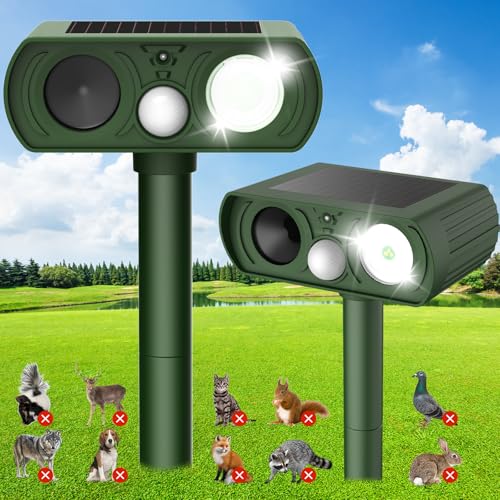
【Effectively Drive Away Animals】Once the advanced motion sensor detects animals nearby, the deer repellent devices activate, emitting strong ultrasonic sounds and flashing LED strobe lights. The ultra-powerful sonic & light scare animals away and effectively deter them from your protected area in a peaceful way.

【5 Different Working Modes】 This ultrasonic mouse repellent features state of the art ultrasonic technology which creates a powerful ultrasonic wave,accompanied at the same time by an alarm sound. Ultrasonic animal repellers scare them away from your house, garden, yard and stop animals from ravaging your favorite plants.
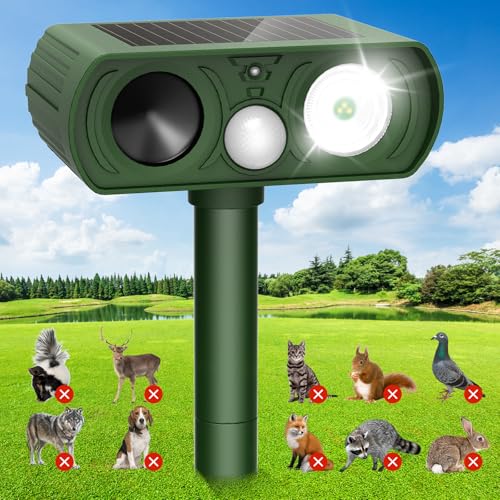
【Effectively Drive Away Animals】Once the advanced motion sensor detects animals nearby, the deer repellent devices activate, emitting strong ultrasonic sounds and flashing LED strobe lights. The ultra-powerful sonic & light scare animals away and effectively deter them from your protected area in a peaceful way.
4. Use Deterrents

Motion-activated lights, sprinklers, and noise devices all exploit the same raccoon trait: they startle easily but adapt fast.
A single sprinkler near the garbage cans or garden edge will work for maybe three nights before the local raccoons treat it as scenery. The fix is rotation.
I run the sprinkler one week, switch to a strobe light the next, then park a battery-operated radio tuned to an all-night talk show under the deck for a few nights.
Human voices spook them more than music does; ultrasonic devices never matched that success for me, and the neighbors complained less about the radio than about the high-pitched boxes.
Timing is the detail that makes or breaks this. Raccoons do most of their damage from sunset to midnight, not in the small hours.
Deterrents left running all night waste battery and wear out the surprise; set them on a timer for the first five hours after dark and you catch the real action.
For vegetable beds or ponds, a two-wire electric fence placed at 6 and 12 inches above ground stops climbers cold.
Run it on a timer so it only fires after dark; that keeps the electricity bill modest and avoids shocking the dog on morning patrol.
Recommended Products

STURDY CONSTRUCTION — 304 STAINLESS STEEL:GMOTLSE 304 stainless steel hardware cloth is made of genuine 304 stainless steel with solid welding points and strong tensile strength, ensuring the mesh holds its shape under long-term use. Even when exposed to moisture or outdoor elements, this 304 stainless steel wire mesh stays rust-free and reliable for years

【Specification and Size】:Hardware cloth is 1/2 inch mesh, width: 48 inches (1.22m), length: 100 feet(30.5m), Green Vinyl PVC Coated Mesh, 19 Gauge Metal Wire,soft chicken coop fabric,mouse proof fencing,mesh screen roll

PREMIUM 304 STAINLESS STEEL – Made from durable 304 stainless steel for excellent corrosion resistance and long-lasting indoor or outdoor use.
5. Consider Humane Trapping

Humane trapping sits at the back of the line for a reason. Trapping works best as a last resort, not a first move, and local permits and relocation laws are the reason why.
Relocation is illegal in many states without permits, and even where it is allowed, California law caps distance at a few miles from the capture site to slow disease spread.
A licensed wildlife removal service handles this compliance for you, which is worth the call if you are unsure of your local rules.
The real risk with DIY trapping is not the trap itself. A caught adult may leave dependent young in a den you never found, and those young starve without her.
Poison is worse, it is inhumane, often illegal, and secondary poisoning can hit pets or other wildlife that scavenge the body.
Removing the attraction, the food source, the shelter, fixes the problem without creating orphans or breaking a state regulation you had not checked yet.
Recommended Products

【High Quality】Made of high quality silicone, draft sealer for doors is soft, flexible, and resistant to hot and cold weather. Also offers advantages of corrosion and aging resistance. Door draft seal is 0.08 inches / 2 mm thick. Thicker than most other products, Door draft tape has a better seal. Width is 3 inch fits 0-1.5 inch gap

SOLD ON AMAZON FOR OVER 5 YEARS: Enjoy our adorable Evelots Cat under door draft stoppers for years. Weighted with sand, keep cold air out and heat in. Cool and heat your home more efficiently with this animal-themed 38 inch fabric door draft blocker

SOLD ON AMAZON FOR OVER 5 YEARS: Enjoy our adorable Evelots 2 Pack Cat under door draft stoppers for years. Weighted with sand, keep cold air out and heat in. Cool and heat your home more efficiently with this animal-themed 38 inch fabric door draft blocker
6. Maintain Yard Cleanliness

Fallen fruit is the bait you didn’t know you were setting.
Last September I found three peaches rotting under a tree I thought I’d finished with, and the raccoon prints in the soft ground nearby told me exactly who’d found them first.
Late summer and autumn demand more frequent cleanup, not less, because a single overripe apple or split tomato becomes a reliable food source that undoes every other step you’ve taken.
I now walk the yard twice a week from August through October, checking beneath fruit trees and vegetable rows. Windfalls collect fast, and raccoons remember where they found food last time.
A compost bin helps only if it has a locking cover; an open pile is just a buffet with walls.
The same goes for bird feeders, which need to come in at night or hang where a raccoon can’t reach them.
Yard debris matters too. Piles of leaves, twigs, and branches give raccoons shelter to wait out the day near your house.
Keeping the ground clear removes hiding spots and forces them to move on to quieter territory.
Recommended Products
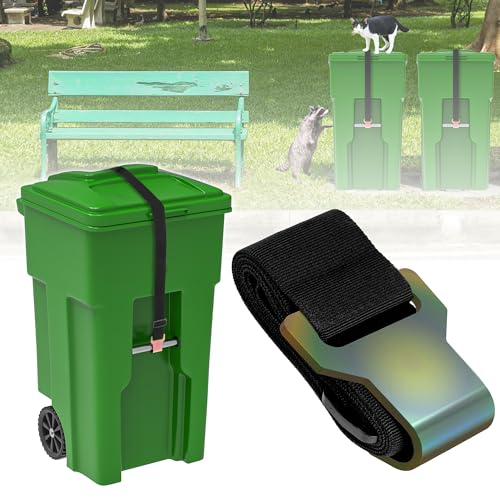
Locking trash can lids from opening: Are you tired of having to clean up the trash that is strewn about every day after a raccoon gets into your trash can? Or do you often have strong winds coming through your town blowing away trash can lids/blowing over your trash cans? Our outdoor trash can lid lock can be used to secure your trash can lid, not only to prevent animals from getting into your trash can, but also to prevent strong winds from blowing away your trash!

Animal & Weather Resistant : A practical trash can lock strap that keeps your outdoor bin sealed—helps deter bears, raccoons, squirrels, pets, and gusty wind from opening or tipping the lid. Ideal for home, curbside, camping, and other outdoor use. A simple trash can lock solution for raccoon proof garbage cans and bear proof trash can setups."

MOSTLY UNIVERSAL STRETCH LATCH: Attach to most garbage and recycling containers (32–96 gallons). Keeps lid shut. Can must have a handle. Patented (US Pat. No. 10,294,022). Stretch to lock and unlock.
Raccoon Behavior and Health Risks

Raccoons work the night shift with skills that make most backyard defenses look like suggestions.
Their front paws work almost like hands, letting them pry open latches, twist off unsecured lids, and shimmy up downspouts you’d think too smooth to climb.
I watched one figure out a bungee-corded trash can in under ten minutes, and that was after it had already failed twice. They remember what worked.
They teach their young. A deterrent that worked in June may be useless by August if the same raccoon has had time to puzzle through it.
The health side matters just as much as the property damage. Raccoon feces carry Baylisascaris procyonis, a roundworm parasite that can survive in soil for years and causes serious, sometimes fatal, illness in humans if eggs are ingested.
Children face higher risk simply because they put more hands and objects in their mouths. Boiling water treats contaminated ground; bleach does not kill these eggs.
Rabies sits lower on my worry list than you’d expect. The raccoon strain has killed exactly one human in CDC records, and post-exposure treatment works well if you seek it promptly.
A raccoon active in daylight isn’t automatically sick; nursing mothers often forage extended hours. The ones to watch for are those circling, staggering, or vocalizing strangely.
Call animal control for those, not the one quietly raiding your compost at dusk.
Recommended Products

PRESERVE FRESHNESS AND FLAVOR: This airtight pet food container helps your pet's dry food to stay tasty with its Gamma Seal Technology; It maintains moisture balance to keep food tasty and fresh

FOOD FOR ALL: For your cats, dogs, birds, and more. Store your pet's dry foods into sealable and portable pet food container. 67 Qt size food storage container is great for storing around 58 Lb of dry food (capacity depends on the kind of food you store)

PRESERVE FRESHNESS AND FLAVOR: This airtight pet food container helps your pet's dry food to stay tasty with its Gamma Seal Technology; It maintains moisture balance to keep food tasty and fresh
Deterrent Comparison

Spike strips around deck posts stopped my raccoon visitor permanently after sprays failed. The strips took about an hour to install with zip ties, but they work because raccoons climb delicately and avoid pain.
Cayenne and ammonia-soaked rags helped briefly, yet rain and dew washed them away within days. A radio left running did nothing the ultrasonic repeller didn’t also fail to do.
| Deterrent | What it targets | Upkeep | Best for |
|---|---|---|---|
| Spike strips | Touch; climbing routes | Install once, check seasonally | Permanent deck or fence access |
| Sealing gaps/steel mesh | Shelter entry | Inspect yearly after storms | Under decks, attics, sheds |
| Cayenne or ammonia sprays | Smell/taste | Reapply after rain | Temporary spot protection |
| Radio or ultrasonic | Hearing | Daily battery or outlet cost | n/a; skip these |
Start with spike strips if raccoons climb to your deck. They cost little and outlast every spray.
For ground-level intruders, seal gaps with steel mesh first; raccoons squeeze through openings smaller than you’d expect. Ammonia in garbage cans works as a backup layer, not a main defense.
Ultrasonic devices and radios burn electricity without reliable results in my reading.
Recommended Products

Advanced Motion Detection for Instant Protection - Equipped with a highly sensitive PIR motion sensor, this solar ultrasonic animal repellent activates immediately when movement is detected, emitting ultrasonic waves and flashing LED lights to scare animals away quickly and effectively.

【Early-Fall Deer & Garden Protection】Deer feeding around flowers, hostas, vegetables and fruit trees can remain a major yard problem into early fall. These deer repellent devices use motion-activated ultrasonic and light deterrence to help interrupt approaching deer, while also discouraging rabbits and squirrels around flower beds, vegetable gardens and landscaping.

【5 Different Working Modes】 Our gdend Ultrasonic Animal Repellent effect on Deer,Cat, Squirrel, Raccoon, Dog, Skunk, Rabbit and other outdoor animals. Depending on the working mode you choose, it will emit ultrasonic waves of different frequencies that only animals can hear. Notes:Animals may respond differently to each mode of the repellent, even within the same species. If one mode does not seem effective, we recommend trying others to determine the most suitable setting.
Natural Repellents and What to Skip

Most natural repellents for raccoons disappoint in practice, so the choice of what to try matters.
- Cayenne pepper can work against squirrels, but raccoons mostly ignore it. One test found a raccoon still bit into pepper-dusted vegetables and simply tossed them aside; the spice on decking and railings did not slow it at all. Skip this for raccoons.
- Vinegar and ammonia smell strong enough that you would expect results, yet a raccoon climbed past both sprays and even removed ammonia-soaked tennis balls wedged into a concrete block. Rain washes the reapplication away fast, so any benefit stays nominal.
- Ammonia in garbage cans has slightly more backing: a cup poured inside each can, or ammonia-soaked rags secured on lids with bungee cords, appears in extension guidance as part of a broader securing strategy. The smell is what drives raccoons off, not the chemistry, so reapply it after rain or every few days.
- Predator urine and commercial repellents sit in a gray zone. They exist, but broad, reliable evidence of consistent success is hard to pin down. I would not spend money here before locking down food sources and access points.
- What to skip outright: the hot-sauce spray (one gallon water, two tablespoons hot sauce) and the grub-zone mix (eight ounces Dawn, chewing tobacco, water) target symptoms, not the raccoon’s reason for visiting. If the yard still offers food or shelter, the animal adapts around the smell.
Recommended Products

High-Strength Low Carbon Steel: Made with high-quality low carbon steel, this hardware cloth is designed for strength and reliability in applications such as animal enclosures and garden projects.

【Triple-Layer Anti-Rust Construction】 Crafted with premium 23-gauge fully annealed steel wire, reinforced with electroplating zinc and topped with non-lead black vinyl coating. This three-layer design delivers superior rust prevention, corrosion resistance, and long-lasting durability, ideal as hog wire fence and fencing for yard use in harsh outdoor conditions.

Premium Materials and Welding Craftsmanship: Constructed from 19-gauge low-carbon steel wire, the material undergoes a hot-dip galvanizing process prior to welding. This specialized technique ensures uniform mesh spacing and creates weld points that are exceptionally strong and secure. The standard hot-dip galvanized anti-corrosion coating requires no maintenance and remains effective for over 20 years; even in coastal regions or environments with heavy industrial pollution, it maintains stable performance for 15 to 20 years.
When to Call a Professional

Some raccoons leave after a single night of finding nothing worth eating. Others settle in, and the line between a backyard visitor and a persistent problem is worth watching closely.
A raccoon that returns for three or more nights, or one that starts leaving visible latrines near the foundation or under decks, is signaling that it has claimed territory rather than just scavenging.
Once a raccoon is sick, cornered, or inside your walls, calling a pro is the safer choice.
The health risks shift the math quickly.
Raccoon feces often carry Baylisascaris procyonis, a parasite that is harmless to the animal but can be dangerous, even fatal, to humans, particularly children who may put contaminated soil or objects in their mouths.
The eggs survive most chemical treatments, including bleach; boiling water is one of the few reliable ways to kill them. Raccoons can also carry leptospirosis, spread through infected urine, and rabies, though reports vary by region.
If a raccoon appears in daylight, moves strangely, or has visible discharge, those are signs to back away and call someone with the right equipment and vaccines.
Legal considerations complicate the do-it-yourself route more than most gardeners expect. Many states restrict how far a trapped raccoon can be moved, and some prohibit relocation entirely to prevent disease spread.
California, for example, bars moving raccoons more than a short distance from the capture site. A licensed wildlife removal service will know the local regulations and have the permits to comply with them.
If you are unsure about trapping laws in your area, a professional is not an expense; it is a shield against a misdemeanor you did not know existed.
Frequently Asked Questions
Why is there a raccoon in my backyard at night?
Raccoons enter backyards looking for food or shelter. They are drawn to unsecured garbage, ripe garden produce, pet food left outside, and quiet places to den.
Once they find a reliable food source, they remember the location and return on schedule. Their most active hours run from sunset to midnight, which is when you are most likely to spot them.
How can I keep raccoons out of my trash?
Secure lids with bungee cords or switch to heavy-duty cans with raccoon-proof locks. If possible, store bins inside a garage or shed until pickup day.
Double-bag meat scraps and freeze fish between collections to reduce odor, since smell is what draws them across property lines in the first place.
What should I do if I see a raccoon in my yard?
Do not approach it. Raccoons are naturally shy and will retreat, but they can attack when cornered or protecting young.
Instead, remove food sources like pet bowls and secure your trash, then set deterrents for the first five hours after dark when they are most active.
If the animal behaves strangely, circling or staggering, call animal control rather than handling it yourself.
How do I know if I have a raccoon problem?
Look for hand-shaped tracks with five splayed fingers, blunt-ended droppings about three-quarters of an inch across, and ragged digging damage in lawns or garden beds. Oily smudges on fence rails or downspouts from climbing are another tell.
Confirming raccoons rather than skunks or squirrels before you act keeps you from wasting effort on the wrong target.
Is it bad to have a raccoon in your yard at night?
A single visitor is usually not an emergency, but raccoons can cause real problems. They tear up lawns hunting grubs, raid gardens systematically, and scatter garbage.
Their feces carry Baylisascaris procyonis, a roundworm parasite that survives in soil for years and can cause serious illness in humans, especially children.
A raccoon that returns for multiple nights or leaves latrines near your foundation has likely claimed territory and needs stronger action.
How do you encourage raccoons to leave?
Remove every food source, seal shelter access points as small as four inches, and rotate deterrents weekly so they cannot adapt.
Motion-activated sprinklers, lights, or a radio tuned to talk radio work best when swapped regularly; a single method loses effect in about three nights.
For climbing routes, spike strips around deck posts or aluminum flashing on tree trunks provide more lasting results.
What smell do raccoons hate the most at night?
No single smell reliably repels raccoons for long.
Ammonia has the most backing as a supporting tactic: a cup poured inside garbage cans or ammonia-soaked rags secured on lids can add a deterrent layer, but the scent fades and must be refreshed.
Cayenne pepper, vinegar, and predator urine generally fail because raccoons either ignore them or simply move to another part of the yard.
Will raccoons come back if you scare them at night?
A sudden scare may send a raccoon running, but they startle easily and adapt fast. The same deterrent, whether a motion light or sprinkler, typically works for only a few nights before they treat it as background noise.
To keep them from returning, you need to rotate methods and, more importantly, remove the food or shelter that brought them in the first place.