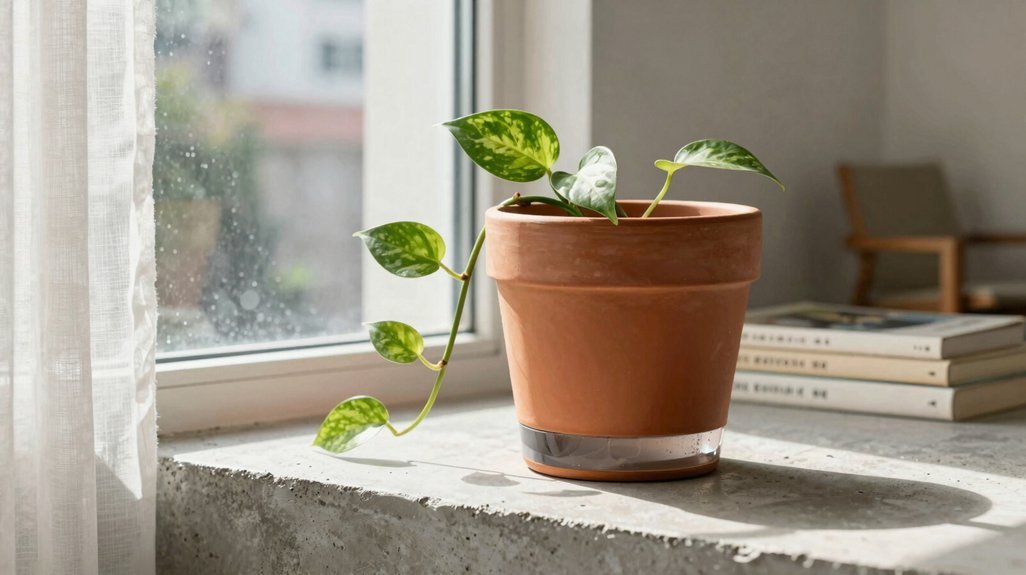
Self-watering pots use a reservoir system (a water storage chamber below soil) that lets plants drink through capillary action, which is water moving upward through porous material. I look for four things: reservoir size, wick quality, drain holes, and price per unit.
These five picks suit beginners who forget weekly watering, though you’ll still need to refill reservoirs. My favorite? The YNNICO six-pack delivers serious value. But one option hides a flaw that rots roots fast.
YNNICO Indoor Self Watering Planters, 6-Pack (Black)
The YNNICO Indoor Self Watering Planters operate through a dual-chamber mechanism: the upper section holds your plant and soil, while the lower reservoir stores water that travels upward through a string wick (a fiber cord that pulls moisture to roots by capillary action, like oil moving up a lamp wick). This system prevents root rot.
The six-pack delivers exceptional value. You receive six graduated sizes—5″ through 8″—which accommodate most indoor plants. The thick 4mm polypropylene walls feel substantial. My favorite feature: the watering lip simplifies refilling without disturbing soil.
These planters suit beginners who forget watering schedules. However, the string wick requires occasional replacement. I recommend these for office environments and gift-giving.
Best For: Busy beginners, office workers, and gift-givers seeking low-maintenance indoor planting with graduated sizes and a modern aesthetic.
Pros:
- Self-watering string wick system with separate reservoir prevents root rot and reduces watering frequency
- Six graduated sizes (5″-8″) accommodate various small to medium plants at strong value
- Thick 4mm polypropylene construction feels substantial while remaining lightweight and durable
Cons:
- String wick requires occasional replacement over time
- Self-watering effectiveness depends on proper wick positioning and maintenance
- Limited to indoor use; saucer/reservoir design may not suit all aesthetic preferences
Bluepro 18 Pack Self Watering Plant Pots
Who needs variety without the guesswork? I’ve found my answer in the Bluepro 18 Pack Self Watering Plant Pots. This set delivers six pots each in three sizes—4″, 5″, and 6.5″—giving me flexibility for seedlings, herbs, and mature houseplants alike.
The mechanism works through a bottom water tray connected to watering rope, a fibrous cord that draws moisture upward into soil. I fill the reservoir; the system sustains plants for one week. Clear BPA-free plastic lets me monitor root growth and soil moisture directly.
Multiple drainage holes prevent root rot, the fungal damage caused by stagnant water. These suit gardeners wanting scale without complexity. The flexible walls protect roots during transplanting. Reinforced edges withstand repeated indoor and outdoor use.
My favorite feature: transparency eliminates watering guesswork entirely. I recommend these for propagation-heavy growers. One caveat—non-recycled plastic prioritizes durability over sustainability.
Best For: Propagation-heavy growers and gardeners seeking a flexible, low-maintenance solution for seedlings, herbs, and houseplants who value visibility into root health and soil moisture over sustainability.
Pros:
- Self-watering system with bottom tray and fibrous rope sustains plants for up to one week with minimal effort
- Transparent BPA-free plastic enables direct monitoring of root growth and soil moisture, eliminating watering guesswork
- Three sizes (4″, 5″, 6.5″) with flexible walls and reinforced edges support diverse plants and repeated indoor/outdoor transplanting
Cons:
- Constructed from non-recycled plastic, prioritizing durability over environmental sustainability
- Limited to approximately one week of hydration, requiring periodic refilling for extended absences
- Clear plastic construction may show soil staining or algae growth over time with sun exposure
YNNICO Indoor Self Watering Planters 6-Pack (White)
Plant lovers seeking variety will find their match here. The YN.NICO Indoor Self Watering Planters arrive as a six-pack in white, ranging from five to eight inches. I appreciate this size spread because it accommodates different growth stages without forcing repotting emergencies.
The mechanism works through multiple drainage holes at the base, plus a large bottom tray that captures excess water. This reservoir, a separate storage compartment, keeps soil distinct from standing water. Root rot risk drops because air circulates freely.
I choose these when gifting beginners. The durable polypropylene, a sturdy plastic, survives drops. Four-millimeter sidewalls give real thickness, not flimsy collapse. Matte finish blends anywhere.
Match caveat: These excel for small-to-medium plants only. Large specimens outgrow the eight-inch maximum fast.
My favorite feature? The bottom-watering option. You pour into the tray; roots drink upward. This mimics natural groundwater absorption.
Best For: Plant lovers and beginners seeking a versatile set of coordinated self-watering planters for small-to-medium indoor plants.
Pros:
- Six varying sizes (5–8 inches) accommodate different growth stages and plant types without immediate repotting needs
- Self-watering design with separate reservoir and drainage holes reduces root rot risk while enabling bottom-watering for natural root absorption
- Durable 4mm thick polypropylene construction with matte finish withstands drops and blends with modern home or office décor
Cons:
- Eight-inch maximum size limits use to small-to-medium plants only; large specimens outgrow the set quickly
- Plastic material may lack the premium aesthetic of ceramic or terracotta alternatives for some users
- Self-watering reservoir requires monitoring to prevent stagnant water or mosquito breeding if not maintained properly
QRRICA Self Watering Plant Pots, Set of 5
Looking for one set that handles every plant size? I found it. The QRRICA Self Watering Plant Pots deliver five graduated planters—10, 9, 8, 7.5, and 7 inches—that accommodate everything from compact African Violets to spreading Monsteras.
Here’s the mechanism. Each pot contains a removable watering feeder with a bottom string, a cotton wick that draws water upward from the reservoir. Mesh drainage holes separate soil from standing water, preventing root rot while maintaining consistent moisture.
The system works through capillary action, simple physics.
Purchase criteria: durable recyclable plastic, matte black finish, indoor-outdoor versatility. These are lightweight but sturdy. My favorite feature is the graduated sizing—it eliminates guesswork.
You’ll match with this set if you maintain diverse plants across multiple spaces. Warning: the all-black aesthetic dominates; it doesn’t blend with bright decor.
I recommend this for collectors building cohesive displays. The five-size range justifies the investment.
Best For: Plant collectors who maintain diverse indoor and outdoor greenery and want a cohesive, graduated set of self-watering pots that eliminate size guesswork.
Pros:
- Five graduated sizes (7–10 inches) accommodate everything from compact African Violets to spreading Monsteras in one purchase
- Self-watering cotton wick and separate reservoir prevent root rot while maintaining consistent soil moisture
- Durable, lightweight recyclable plastic with modern matte black finish suits both indoor and outdoor environments
Cons:
- All-black aesthetic dominates spaces and clashes with bright decor schemes
- Cotton wick system requires occasional monitoring to ensure proper capillary function
- No included soil, plants, or decorative accessories—just the empty pots and watering components
Teagas Ceramic Self Watering Pots, 6 Inch Green
The Teagas 6-inch ceramic pot solves a specific problem. It keeps African violets and herbs alive when I forget to water them.
The mechanism works simply. I pour water into the glazed outer pot, which measures 5.9 inches wide and 4.9 inches tall. The unglazed clay inner pot, slightly wider at 6.2 inches, absorbs moisture upward.
This capillary action, water moving through porous material, maintains steady humidity without drowning roots. I reduce my watering frequency significantly.
I recommend this pot for beginners and busy gardeners. The green glaze suits desks, bathrooms, and offices.
It accommodates small plants: pothos, fittonia, basil, and my favorite, peace lilies.
One caveat: only the ceramic planter arrives. I supply my own plant. For gifting, it works well. Support responds promptly if issues develop.
Best For: Busy gardeners and beginners who want to keep small indoor plants like African violets, herbs, and peace lilies alive with minimal watering effort.
Pros:
- Self-watering mechanism maintains steady soil humidity through capillary action, significantly reducing watering frequency
- Premium glazed ceramic outer pot and porous clay inner pot provide durable, attractive construction
- Compact 6-inch size with modern green glaze fits well on desks, in bathrooms, offices, and various home decor settings
Cons:
- Plant not included—buyer must supply their own plant separately
- Inner pot (6.2″ wide) is slightly wider than outer pot (5.9″ wide), which may affect stability or placement
- Limited to small and medium plants; not suitable for larger plant varieties
Factors to Consider When Choosing Self-Watering Pots
I’ve tested enough self-watering pots to wreck three houseplants and learn my lesson. You need mechanism clarity: wicking pulls water up through fabric, while reservoir systems let roots drink directly, because mismatching the type to your plant’s thirst kills it dead.
My favorite buying filter starts with material durability, then checks if the drainage system design prevents root rot. Ceramic costs more but won’t warp, plastic’s light but degrades, and you’ll match aesthetic compatibility last because a dead plant looks worse than an ugly pot.
Size variety matters immensely, especially if you’re growing compact herbs versus sprawling tomatoes, though I warn that oversizing backfires: wet soil rots roots faster than drought.
Pot Size Variety
Why does pot size matter so much? It determines how long your plants survive between refills. A varied set, 5″, 5.5″, 6″, 6.5″, 7″, 8″, accommodates different species and growth stages within one collection. Wider sizes hold more soil volume, extending watering intervals considerably. Smaller pots demand closer monitoring.
I always verify that reservoir capacity and watering rope (the absorbent cord drawing water upward) stay consistent across sizes. This ensures uniform performance. My favorite approach matches root volume to container: herbs in compact pots, foliage plants in larger ones. Grouping diverse plants becomes seamless with identical drainage and reservoir design.
Purchase criteria center on this size spread. One caveat: mismatched systems create maintenance headaches. Choose collections with proportional scaling.
Material Durability
Size variety solves spacing problems, but material quality determines how long your pots actually last. I always check wall thickness first: four millimeter plastic or dense ceramic resists cracks from drops or bumps. My favorite durability feature is BPA-free, recyclable plastic; it fights brittleness far longer than cheap alternatives.
The reservoir connections matter enormously. I insist on integrated, leak-proof joints between the water storage base and the planting chamber. Reinforced edges prevent failure when I lift or reposition filled pots. Smooth interior surfaces reduce abrasion damage from soil and root balls moving against walls.
For versatile use, I select materials rated for both indoor conditions and outdoor temperature swings. This prevents warping or fracture.
I completely avoid thin, flexible plastics regardless of price. Solid construction pays for itself.
Watering Mechanism Type
Although reservoir design shapes every self-watering pot’s performance, the mechanism type determines how water actually reaches your plants. I examine three primary systems.
Bottom-watering designs use a large reservoir with a water-supply interface beneath the soil. This maintains steady hydration through direct soil contact. Wicking mechanisms employ ropes or strings, absorbent fibers that draw water upward through capillary action, sustaining plants for roughly one week. Isolated storage systems separate the water source entirely from root zones, eliminating overwatering risks through physical barriers.
My favorite remains bottom-watering for reliability. You must verify air circulation features accompany any mechanism. Poor airflow causes root rot regardless of delivery method.
Match wicking systems to short trips; choose bottom-watering for consistent home use. Price variations reflect reservoir capacity, not mechanism complexity.
Drainage System Design
How exactly does excess water escape when your reservoir overflows? I always check for a bottom drainage design with multiple holes. These holes promote airflow, which is the movement of air through soil, and prevent waterlogging, a condition where roots suffocate in saturated soil.
A separate water reservoir or saucer keeps water away from roots entirely. This isolation dramatically reduces root rot risk. My favorite feature is a reliable reservoir connection, typically a watering rope or string, that sustains moisture between my refills. Transparent components help me monitor water levels directly.
I verify that excess water cannot reach the root zone. Flooding ruins plants quickly. Purchase pots with visible drainage mechanics. Match this design if you travel frequently: however, avoid unclear reservoirs. I strongly recommend verified isolation systems.
Aesthetic Compatibility
The finish you select sets the tone. I always choose matte black, white, or glazed ceramic because these finishes complement existing decor for a cohesive look. Consider whether a transparent pot or an opaque pot, which blocks light, better serves your space. Transparent pots show soil moisture, while opaque options match surrounding tones more discreetly.
I match silhouette to setting: modern minimalist lines suit offices, while classic round shapes fit traditional homes.
Scale matters enormously. I size pots, typically five to eight inches, to surrounding furniture for balanced visual appeal. Oversized pots overwhelm; undersized ones disappear.
Reservoir design demands scrutiny. I reject visible plastic components that clash with decor. Hidden reservoirs integrate seamlessly. My favorite solution: ceramic reservoirs that read as base detail. This preserves function without sacrificing style. Prioritize integration. Your space benefits.
Plant Type Suitability
Why does one pot thrive where another fails? The answer lies in plant type suitability.
Match the pot size to your plant’s mature width. Crowded roots suffocate. Proper space guarantees healthy growth.
I always check humidity needs next. Some self-watering pots keep soil wet continuously; others dry faster. High-humidity plants love steady moisture. Dry-condition species need quicker drainage.
Look for a separate water reservoir, my favorite feature. This chamber sits below the soil, storing water apart from roots. Sensitive plants avoid waterlogging and root rot, their death sentence.
Material matters enormously. Plastic retains moisture longer. Terracotta breathes and dries fast. Match this to your plant’s light and temperature needs.
Finally, verify the mechanism. Bottom trays and watering ropes deliver water differently. Ensure the system matches your plant’s weekly or daily drinking habit. Precision prevents failure.
Indoor Outdoor Versatility
Where do you actually need these pots to perform? Separate water reservoirs minimize splashing indoors. Weather-resistant materials withstand sun and rain outdoors. This dual functionality demands specific features.
Drainage holes and air circulation, openings that let roots breathe, protect plant health on windowsills or patios. Transparent designs reveal water levels instantly. You see moisture without disturbing soil.
UV-resistant plastics or ceramic finishes determine lifespan outside. Lightweight options favor indoor portability. These material choices directly impact your investment timeline.
Sets with varying sizes enable mixed planting anywhere. You won’t swap containers seasonally. My favorite approach matches pot durability to your primary location, then accepts secondary use as a bonus. Buy UV-rated pieces if outdoor exposure exceeds forty percent of the year.
Maintenance Requirements
Beyond placement decisions, I evaluate how much attention each pot demands from me weekly. Self-watering pots require monitoring the water reservoir level to prevent neglect or overflow. I look for a clearly accessible fill port or easy-to-clean reservoir to maintain consistent moisture. This matters for busy or beginner gardeners.
Some models use a water-absorbent inner pot or wicking rope, a fiber that draws water upward. I ensure the system matches my plant’s needs for steady moisture without root rot. Drains and air circulation holes prevent waterlogging. Multiple drainage holes improve soil aeration, which lets roots breathe.
Reusability and durability influence long-term maintenance. Sturdy pots resist cracking and facilitate repeated use. My favorite choice combines recyclable plastic with simple cleaning access. Avoid complex mechanisms.